


The Traveler's GMT
What it is, how it works, and why the Hyperion has one.
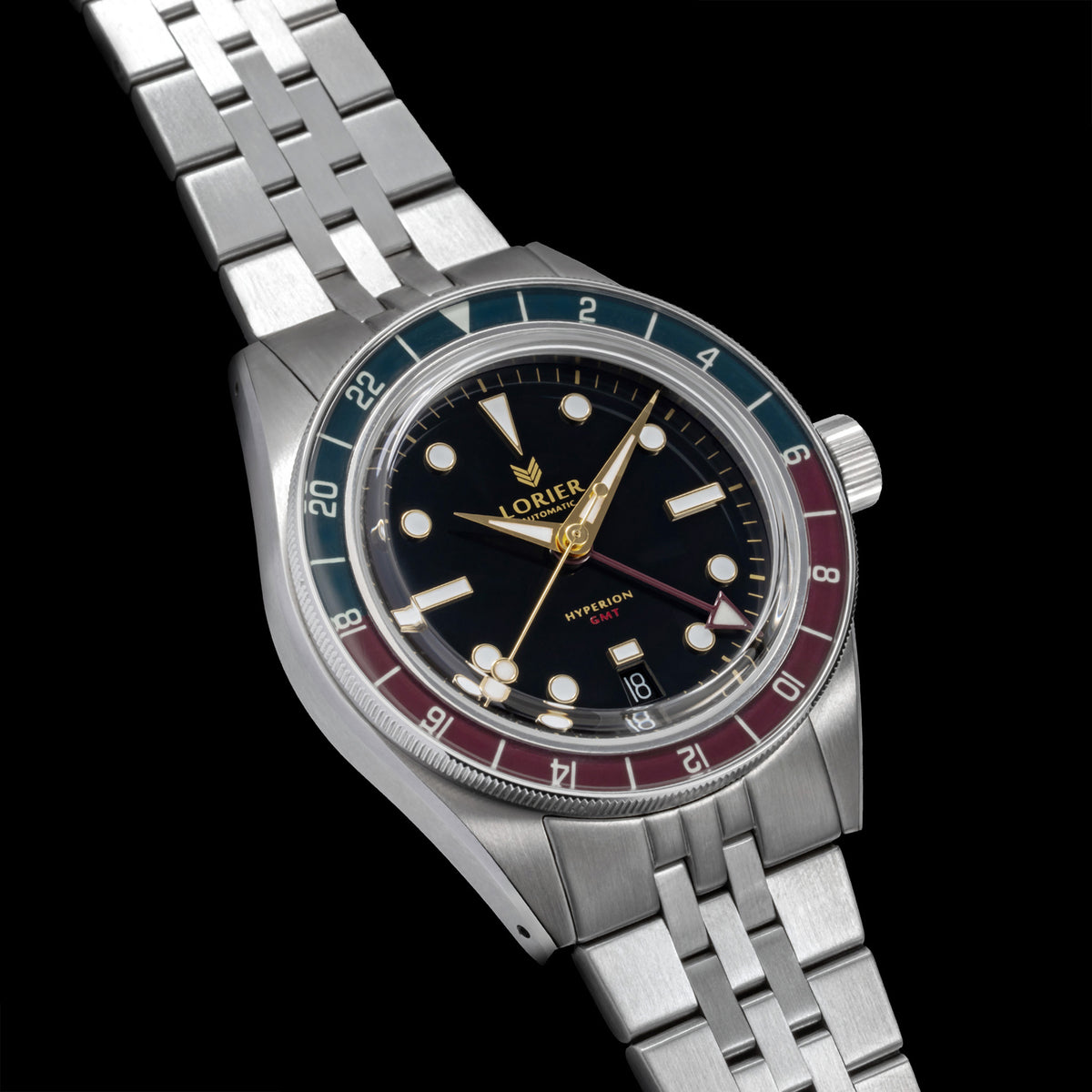
Every GMT watch tells at least two times at once. What separates one GMT from another is which hand moves when you land. On a traveler's GMT, it's the hand you actually need. Here's how it works, where it came from, and how we put it to work in the Hyperion.
- What it is
- A GMT whose local hour hand jumps on its own, in one-hour steps, while the watch keeps running
- Also called
- True GMT, flyer GMT
- The alternative
- Caller or office GMT, where the 24-hour hand jumps instead
- Origins
- A pilot's instrument from the 1950s; the independent hour hand arrived in the early 1980s
- In our collection
- Hyperion, powered by the Miyota 9075
What is a GMT watch?
GMT stands for Greenwich Mean Time. In 1884, the International Meridian Conference agreed to measure longitude, and time, from a single line through Greenwich, England. Twenty-four time zones followed.
A GMT watch adds a fourth hand to the dial. It circles once every 24 hours instead of every 12, pointing to a 24-hour scale on the bezel. Set it to one time zone, set the main hands to another, and you can read both at a glance, including whether it's day or night in the place you aren't.
Two kinds of GMT
Every GMT has one hand that can be set on its own. The question is which one.
On a caller GMT, it's the 24-hour hand. The main hour hand stays tied to the minutes. It's built for someone who stays put and keeps an eye on somewhere else: a colleague in London, family in Seoul. Set the 24-hour hand once and leave it.
On a traveler's GMT, the logic flips. The local hour hand jumps on its own, in one-hour clicks, forward or back, while the 24-hour hand holds home time. It's built for someone who moves.
| Caller GMT | Traveler's GMT | |
|---|---|---|
| Independent hand | 24-hour hand | Local hour hand |
| Built for | Tracking a second zone from home | Moving between time zones |
| Changing time zones | Stop the watch, reset the main hands, then reset the 24-hour hand | Click the hour hand to local time. Nothing else moves. |
| Watch keeps running | No, it stops while you reset | Yes |
| Date | Advances with the main hands | Follows the local hour hand, forward or back |
Why a traveler's GMT is the better travel watch
The GMT was invented for people who cross time zones. The traveler's version is the one that serves them.
Think about landing. On a caller GMT, the main hands, the ones you read a hundred times a day, are tied to the minutes. To bring them to local time, you pull the crown, stop the movement and wind the hands around. The 24-hour hand moves with them, so then you set it back to home. Every flight costs you a few minutes of fiddling and a few seconds of accuracy.
On a traveler's GMT, you pull the crown one click and turn. The hour hand steps to local time. The minutes don't move. The seconds keep running. Home time stays exactly where you left it. And because the date follows the local hour hand, it rolls forward or back as you pass midnight, even across the date line.
The caller has its place. If you never leave home and want a second zone on your wrist, it does the job, and it's mechanically simpler. But a watch worn in transit should keep its main display right without stopping. That's the traveler's GMT.
A brief history
The GMT was a pilot's tool before it was anything else.
As transoceanic flight became routine in the 1950s, airline crews were crossing more time zones in a day than most people crossed in a lifetime. Pan Am's pilots needed reference time readable alongside local time, without doing arithmetic at altitude. The answer was a watch with a 24-hour hand and a rotating, two-color bezel: one half for daylight hours, one for night.
For nearly three decades, that was the GMT. A 24-hour hand and a bezel. Changing local time still meant stopping the watch.
In the early 1980s, the independent local hour hand arrived. Pull the crown, step the hour, keep going. It's the format serious travelers have preferred ever since.
How it works on the Hyperion
The Hyperion's crown screws down. Unscrew it first, then:
- Before you leave, set home time. Pull the crown to the second position. The seconds hand stops. Turn the crown until the 24-hour hand reads home time against the bezel, set the minutes, and push the crown in.
- When you land, set local time. Pull the crown to the first position and turn it. The hour hand jumps one hour at a time, forward or back, and the date follows it. Push the crown back in. The watch never stopped.
- Need a third zone? Use the bezel. The 24-click bidirectional bezel turns in one-hour steps. Rotate it by the hour difference between home and a third city, then read the 24-hour hand against the shifted scale. Local time on the main hands, home on the 24-hour hand, a third city on the bezel.
The blue and burgundy bezel carries the original logic: one color for the hours the sun is up, one for when it's down, a distinction made easy at a glance.
Built for the jet age

We built the Hyperion as a flight instrument from a more elegant age, the way the first GMTs were. A two-tone 24-hour bezel. A chapter ring and gilt accents.
Our first Hyperion used the Soprod C125. For Series II, we introduced the switch to the Miyota 9075, which we continue to use in the latest version of the Hyperion.
Frequently asked questions
What's the difference between a true GMT and a caller GMT?
On a true, or traveler's, GMT, the local hour hand can be jumped independently. On a caller GMT, the 24-hour hand is the independent one. The first is built for travel, the second for tracking another zone from home.
Is the Hyperion a true GMT?
Yes. The Miyota 9075 lets the local hour hand jump in one-hour steps, forward or back, without stopping the watch.
Does the date change when I move the hour hand?
Yes. The date follows the local hour hand, so it advances or goes back as you pass midnight in either direction.
Can a GMT watch track three time zones?
Yes. With a rotating 24-hour bezel like the Hyperion's, the main hands show local time, the 24-hour hand shows a second zone, and rotating the bezel by the hour difference gives you a third.
What does GMT stand for?
Greenwich Mean Time, the reference time set at Greenwich, England, in 1884. Today it's effectively interchangeable with UTC for everyday use.
